
On this page
Start with three decisions
The city at a glance
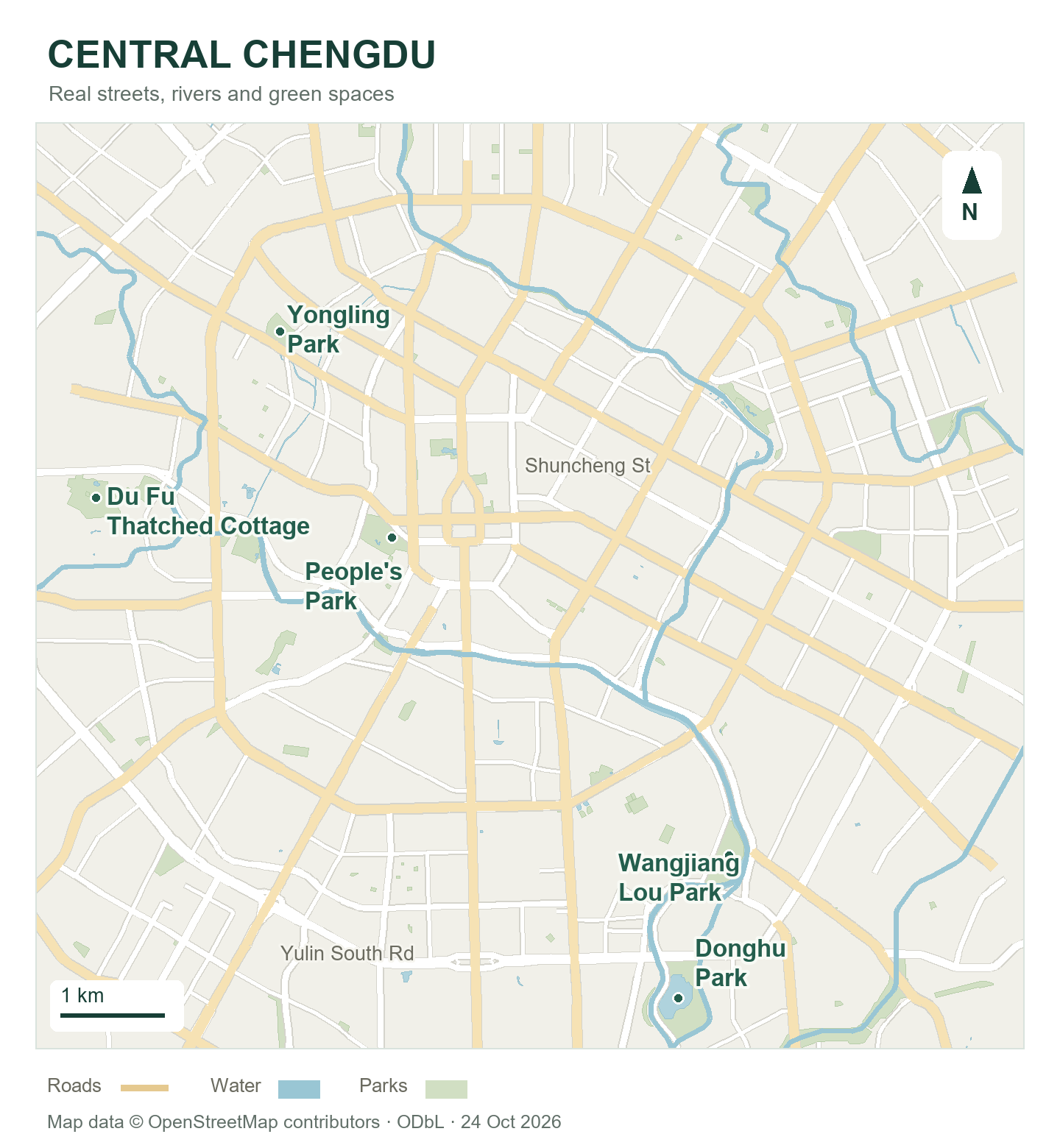
Chengdu is the capital of Sichuan and one of western China’s largest cities. More than 20 million people live in the wider municipality, but most of what a visitor wants sits in a compact central area around Tianfu Square, ringed by the Second Ring Road and the old river loop.
The important mental adjustment is scale. “Central” neighborhoods are walkable one by one, but crossing between them can take 20–40 minutes by metro or taxi. Group your days by area, and resist the urge to cross the city for a single sight.
- Province
- Sichuan
- Airport codes
- TFU (Tianfu) and CTU (Shuangliu)
- Currency
- Chinese yuan (¥, CNY)
- Language
- Mandarin; Sichuanese in daily life
- Time zone
- UTC+8, no daylight saving
- Power
- 220 V, 50 Hz; plug types A, C and I
- Emergency
- 110 police · 119 fire · 120 ambulance
- Tap water
- Not intended for drinking
Your first 24 hours, in order
- Clear the airport. Immigration queues can take 30–60 minutes at peak times. Have your hotel name and address saved in Chinese before you join the queue.
- Sort out money and data. Activate your eSIM before landing if possible. Withdraw a few hundred yuan from a bank ATM, even if you plan to use Alipay or WeChat Pay.
- Take the metro or an official taxi. The metro is cheapest and easiest before about 22:30. After that, use the staffed taxi queue or a ride-hailing pickup point, never an unlicensed driver who approaches you inside the terminal.
- Check in and register. Hotels register foreign guests and will ask for your passport. Keep the registration slip with your passport; it is useful if you change hotels.
- Eat close to home. Your first meal should not require a city crossing. Ask your hotel for a casual restaurant within a ten-minute walk, then save the bigger food plans for a rested day.
Panda base tickets are sold by real-name reservation, usually up to 14 days ahead, and morning slots are the most useful. If pandas are a priority, book before you plan anything else. The three-day itinerary explains the timing.
Entry rules to check
Entry rules depend on your nationality and on the purpose and length of your trip. Two policies matter most for short leisure visits. They are not interchangeable, and both are updated periodically.
30-day visa-free entry
China offers unilateral visa-free entry for eligible ordinary passport holders for visits of up to 30 days. The NIA country list covers 50 countries. Validity dates differ: the Foreign Ministry FAQ lists December 31, 2026 for 48 countries, December 31, 2027 for Russia, and no expiry date for Brunei. Confirm the conditions and dates for your passport before booking; bilateral visa exemptions are separate policies.
240-hour visa-free transit
The NIA transit policy covers eligible ordinary passport holders from 57 countries for stays of up to 240 hours (10 days). You need a confirmed onward ticket to a third country or region and must use designated ports and remain within the permitted stay areas. Check the official port and area table for your complete route, including any side trips from Chengdu; transit permission is not unrestricted permission to travel throughout China.
Use the National Immigration Administration for the current country list, ports and permitted areas. Airlines can also refuse boarding if your documents do not match the policy in force on your travel date. This page is general information, not immigration advice.
National Immigration Administration (English) (opens in a new tab)
For every visitor
- Check the passport validity required by your entry policy, any visa application, your onward destination and your airline. Do not assume a single six-month rule applies to every visitor.
- Have proof of accommodation and a return or onward ticket available, even if not always asked for.
- Keep a digital and paper copy of your passport and visa or entry stamp.
- If you do not qualify for an applicable visa exemption, obtain the appropriate visa before travel.
How long to stay
Two full days is the practical minimum for a first visit. Three days is the sweet spot: enough for pandas, a central neighborhood, a park and a proper food day without turning the trip into a transfer marathon. Four to five days lets you add a day trip or simply repeat the things you liked.
| Time | What fits comfortably | What to leave out |
|---|---|---|
| 2 days | Panda base, Tianfu Square, Chunxi Road, one teahouse, one hotpot dinner. | Jinli, Du Fu Thatched Cottage and day trips. |
| 3 days | The core route: pandas and Wenshu; People’s Park and museums; Jinli, Wuhou, Du Fu Thatched Cottage and Yulin. | Leshan and Dujiangyan. |
| 4–5 days | The three-day route at a slower pace, plus a day trip to Leshan or Dujiangyan and a free afternoon. | Nothing important — this is the comfortable version. |
| 5+ days | Add Qingcheng Mountain, a cooking class, the Sichuan Cuisine Museum or a second food neighborhood. | Rushing. At this point, stop adding and start lingering. |
If you are continuing to higher-altitude parts of Sichuan or Tibet, build in a rest day in Chengdu before the next leg. Chengdu itself sits at roughly 500 meters, so there is no altitude issue in the city.
Where to stay
Choose a base for the kind of trip you want, not for a single attraction. All five areas below are central enough for a first visit; the differences are atmosphere, hotel stock and how much walking you want at the start and end of each day.
Chunxi Road and Taikoo Li
Best for a first trip, shopping, late dinners and easy metro connections. You are in the middle of the city’s busiest commercial district, with Line 2 and Line 3 nearby.
- Trade-off
- Busy and polished rather than residential. Street noise is worth checking in reviews.
- Getting around
- 20–30 minutes to People’s Park, 30–40 minutes to the panda base, 15–20 minutes to Jinli by metro plus walk.
Tianfu Square
Best for a central, practical base. The square is the geographic reference point, with Line 1 and Line 2 crossing beneath it and several museums within walking distance.
- Trade-off
- Broad roads and civic buildings make it feel less intimate than neighboring areas; fewer small restaurants directly outside the door.
- Getting around
- Direct metro to both main rail stations and easy transfers across the network.
People’s Park and Kuanzhai
Best for atmosphere. Teahouses, old lanes and People’s Park are on the doorstep, and the area is pleasant to walk in the evening.
- Trade-off
- Fewer international-brand hotels and quieter nights. Some boutique rooms are small.
- Getting around
- 10–15 minutes on foot to Tianfu Square; Line 2 at People’s Park station.
Yulin
Best for food and a more residential rhythm. The neighborhood has a dense everyday restaurant scene and a relaxed evening atmosphere.
- Trade-off
- Fewer major sights within walking distance; you will use the metro or taxis to reach the center.
- Getting around
- 20–30 minutes to Tianfu Square by metro; convenient for the southern sights and Jinli.
South Station and Financial City
Best for modern hotels, easy airport access and a quieter business-district base. Line 1 and Line 18 make TFU straightforward.
- Trade-off
- Less of a neighborhood feel; evenings can be quiet. It is not a good base if you want to walk to teahouses.
- Getting around
- 25–35 minutes to the center by metro; quick access to Chengdu South Railway Station.
- Before booking, ask the property to confirm its check-in process for international guests and the documents required. Hotels are responsible for registering foreign guests. Do not assume a separate foreign-guest licence is required; see the published government guidance.
- Check the walk to the nearest metro entrance, not just the distance to the neighborhood.
- Read recent reviews for noise, air-conditioning and bed hardness; standards vary widely.
- Save the hotel name and address in Chinese. A screenshot is useful when a driver’s app cannot find the English name.
If you have an early flight from Shuangliu (CTU), an airport hotel for the final night can be sensible. Do not base yourself near Tianfu (TFU) for a city trip; it is roughly 50 kilometers southeast of the center.
Arriving at TFU or CTU
Chengdu has two international airports, and they are not close to each other. Check your ticket carefully: the airport code is the only reliable guide.
| TFU — Tianfu | CTU — Shuangliu | |
|---|---|---|
| Location | Roughly 50 km southeast of the center | Roughly 16 km southwest of the center |
| Metro | Line 18 to Chengdu South Railway Station, then Line 1 or a taxi. About 33–46 minutes on Line 18, depending on the service. | Line 10 to Taipingyuan, then Line 3 toward Chunxi Road. About 35–45 minutes to the center. |
| Metro fare | About ¥10 for the airport leg | About ¥5–6 to central stations |
| Taxi or ride-hailing | 60–90 minutes; expect roughly ¥180–250 plus tolls | 30–40 minutes; expect roughly ¥50–90 |
| Best for | Many international flights; allow more time on arrival and departure | The closer airport; some domestic and international flights |
Journey times are estimates for normal traffic. Allow extra time during rush hour (roughly 08:00–09:30 and 17:30–19:00) and around public holidays.
If you land at TFU
Follow signs for the metro or the official taxi rank. Line 18 runs to Chengdu South Railway Station; from there, Line 1 reaches Tianfu Square. The express service is faster but does not stop at every station, so check the departure board. For a hotel in Chunxi Road or People’s Park, the metro plus one transfer is usually easier than a taxi after a long flight.
If you land at CTU
Line 10 connects both terminals to Taipingyuan, where you change to Line 3 for Chunxi Road or Line 7 for the loop. The airport is close enough that a taxi is reasonable for two or more people with luggage, especially late at night.
Arrival checklist
- Before leaving the terminal: use an ATM, activate your data plan and fill a water bottle after security.
- Choose your transfer: metro if it is running and you are light on luggage; official taxi queue or ride-hailing if not.
- Have the address ready: hotel name and street address in Chinese, plus a screenshot of the map pin.
- Keep the receipt: useful if you leave something in the car or need to query a fare.
Metro last trains vary by line but generally leave terminal stations between about 22:30 and 23:30. If you land after 22:00, plan a taxi or pre-booked transfer rather than relying on the last train. Airport buses are cheaper but slower and less useful after midnight.
Getting around
The metro is the backbone of a first visit. It is inexpensive, signed in English and avoids the worst traffic. Taxis and ride-hailing fill the gaps, especially at night or when carrying luggage.
Metro
- Fares: distance-based, typically ¥2–10 for visitor journeys; the airport lines cost more.
- Hours: roughly 06:00–23:00, with last trains varying by line and station. Check the board for your specific station.
- Tickets: single-journey machines accept cash and some foreign cards; better, use the transport QR code inside Alipay or WeChat Pay.
- Security: bags are scanned at every station. Allow a few extra minutes at large interchanges.
- Luggage: manageable off-peak; avoid rush hour with large suitcases if you can.
Taxis and ride-hailing
Metered taxis start at around ¥8–9 for the first two kilometers, then roughly ¥1.9–2.2 per kilometer, with a night surcharge. DiDi has an English interface and accepts international cards; Alipay also includes ride-hailing. Use the designated pickup points at stations and airports, and ignore drivers who approach you inside the terminal.
Traffic is heavy around 08:00–09:30 and 17:30–19:00, and rain makes everything slower. For short hops in the center, walking is often faster than either.
Walking, buses and bikes
Individual neighborhoods are excellent on foot, but the city is too large to cross entirely that way. Buses are cheap and extensive but harder without Chinese; Amap can plan routes. Shared bikes are useful if you can register, though foreign-card and identity verification can be a hurdle. Electric scooters are quiet and often use pavements, so look before stepping out.
Trains and day trips
Chengdu East and Chengdu South are the main high-speed rail stations. Book with Trip.com or the official 12306 app; 12306 requires passport verification. For Leshan, Dujiangyan and Chongqing, high-speed rail is faster and more predictable than driving.
Google Maps is unreliable in mainland China. Apple Maps uses local data and works well for central Chengdu; Amap (Gaode) is the most accurate for transit, walking and taxi pickup points. Download an offline map before you fly.
Payments and money
China is a mobile-payment economy. Alipay and WeChat Pay are accepted almost everywhere, from department stores to noodle shops, and both can be linked to many international Visa, Mastercard and UnionPay cards. Set one up before you arrive if you can; verification sometimes needs a text message to your home number.
What to expect
- Platform limits: foreign-card payments are commonly capped at about US$5,000 per transaction and US$50,000 per year, but your app and card issuer may impose lower limits.
- Fees: a service fee of roughly 3% applies to transactions above ¥200, in addition to any foreign-exchange fee from your bank.
- Acceptance: most merchants accept the QR code, but some small vendors cannot process foreign-linked cards. Keep a cash backup.
- Cash: ¥300–500 is plenty for most trips. Use bank ATMs (Bank of China, ICBC, China Construction Bank) and carry your passport; some machines require it.
- Cards: useful at international hotels, malls and some restaurants, but not reliable in small local places.
- Tipping: not expected. Upscale hotels and some international restaurants may add a service charge.
Rough daily costs
| Item | Typical range | Note |
|---|---|---|
| Bowl of noodles | ¥15–30 | More in tourist areas. |
| Restaurant meal | ¥40–90 per person | Shared dishes; hotpot often costs more. |
| Coffee | ¥25–40 | Independent cafés cluster in Yulin and Wangping Street. |
| Metro ride | ¥2–10 | Airport lines cost extra. |
| Panda base ticket | ¥55 | Book ahead; prices can change. |
| Museum entry | Free–¥50 | Many public museums are free with reservation; Du Fu Thatched Cottage is around ¥50. Jinsha is closed for upgrading until spring 2027. |
These are planning estimates, not quotations. Prices vary by venue and season.
Ask the staff whether they accept cash, try a different card in the app, or use an ATM nearby. Keep a second payment method set up before you leave the hotel, and do not rely on a single phone for both maps and money.
Phones and internet
Connectivity is the difference between a smooth trip and a frustrating one. Maps, translation, payment and ride-hailing all live on your phone.
Choose your data option
- Travel eSIM: the simplest option for most visitors. Install and test it before departure; data-only plans are common, so keep your home SIM active for bank texts if needed.
- International roaming: convenient and often routes data through your home carrier, which may keep the services you normally use available. Check the daily cost before you rely on it.
- Local SIM: cheaper for longer stays. Buy from an official China Mobile, China Unicom or China Telecom store with your passport; airport counters are convenient but can be busy.
Many international services, including Google, WhatsApp, Instagram and Facebook, are not directly accessible on mainland Chinese networks. Hotel Wi-Fi uses the same local network. If you need reliable access for work or family, arrange roaming or a travel eSIM before you fly, and follow local laws.
Apps worth installing
- Alipay — payments, metro QR codes, ride-hailing and some translation.
- WeChat — messaging, payments and restaurant menus shared by QR code.
- Amap (Gaode) — the most accurate local maps and transit directions; the English interface is limited but usable.
- DiDi — ride-hailing with an English interface.
- Trip.com — hotels, trains and attraction tickets in English.
- Pleco or your phone’s translation app — camera translation for menus and signs.
Download offline maps, save your hotel address in Chinese, and screenshot the booking confirmation. A small power bank is more useful than a second charger, especially on long days out.
Weather and packing
Chengdu sits in the Sichuan Basin, which means humidity, soft light and plenty of cloud. It is rarely extreme, but it can feel colder in winter and hotter in summer than the thermometer suggests. Rain is possible in any month, and July and August are the wettest.
| Season | Typical daytime range | Conditions |
|---|---|---|
| Spring Mar–May | 10–24°C | Mild and green, with rain increasing. Layers and a light rain jacket are useful. |
| Summer Jun–Aug | 22–30°C | Hot, humid and wet, with heavy downpours in July and August. Start early and plan indoor breaks. |
| Autumn Sep–Nov | 15–25°C | The most comfortable season: less rain, clearer days and good conditions for walking. |
| Winter Dec–Feb | 3–11°C | Damp and gray rather than freezing. Snow is rare; a warm layer and waterproof shoes matter more than a heavy coat. |
What to pack
- Clothing: breathable layers, a light rain shell, comfortable walking shoes with grip, and a warm mid-layer in winter.
- Health: your regular medication in original packaging, a stomach remedy, sunscreen, insect repellent in summer and a small first-aid kit.
- Tech: a universal adapter for A/C/I sockets, a power bank, your eSIM details and a spare charging cable.
- Practical: tissues, hand sanitizer, a foldable bag for markets and a compact umbrella.
The best all-round months are March to June and September to November. Avoid the first week of October (National Day), the Spring Festival period and the May Day holiday if you dislike crowds; prices rise and the panda base fills early.
Everyday essentials
Water, food and toilets
Do not drink tap water. Bottled water is cheap and everywhere, and hotels provide kettles for boiled water. Ice in busy cafés and restaurants is usually fine, but use judgment at small street stalls. Carry tissues: public toilets often do not supply them, and squat toilets are common.
Language
English is limited outside international hotels, major attractions and some cafés. Staff are often helpful with a translation app, a photo or a point at the menu. Save your hotel address in Chinese, learn a few phrases, and do not expect every taxi driver to read pinyin.
Plugs, time and connectivity
Electricity is 220 V at 50 Hz, with plug types A, C and I. China Standard Time is UTC+8 all year, with no daylight saving. Public Wi-Fi may require a Chinese phone number; your eSIM or hotel Wi-Fi is more reliable.
Smoking, photography and accessibility
Smoking is restricted indoors, but enforcement varies; non-smoking rooms are worth requesting. Ask before photographing people, monks or worshippers, and follow signs in museums and temples. Newer metro stations have lifts, but pavements are uneven and older venues may lack step-free access. Check directly with hotels and attractions if accessibility is essential.
Safety
Chengdu is generally safe, including at night. The main everyday hazard is traffic: electric scooters are quiet, fast and sometimes on the pavement. Use crossings, look both ways, and avoid cycling after dark without lights. Petty theft is uncommon but not unknown in crowded markets; keep bags zipped.
Local etiquette
- Teahouses: order a cup of tea, then stay as long as you like. Staff will keep topping up your water for free; there is no need to rush.
- Meals: dishes are shared and rice is ordered per person. Do not stand chopsticks upright in rice. Tapping two fingers on the table is a quiet way to thank someone who pours your tea.
- Temples: dress modestly, keep your voice low and avoid flash photography. Do not photograph worshippers without permission.
- Tipping: not expected in restaurants, taxis or hotels. A service charge may appear at upscale international venues.
- Queues and escalators: queue for tickets and security; stand to the right on escalators where marked. Let passengers exit trains first.
- Markets: polite bargaining is normal in souvenir markets, not in shops with fixed prices. Agree the price before a service is provided.
Help and emergencies
- Police
- 110
- Fire
- 119
- Ambulance
- 120
- Municipal hotline
- 12345 (English support varies)
If something goes wrong
- Lost passport: report it to the local police and contact your embassy or consulate. Keep a copy of the police report and your passport scan.
- Medical care: international clinics exist in central and southern Chengdu, and larger hospitals have international departments. Bring your passport, insurance details and payment method; payment is usually required up front.
- Pharmacy: look for 药店 (yàodiàn). Bring prescriptions in their original packaging and ask your hotel for a recommended pharmacy.
- Lost phone: use find-my services, change your passwords from another device and contact your bank if payment apps were installed.
- Scams: be cautious with unsolicited invitations from strangers to a teahouse, bar or “art show,” and agree on prices before ordering. Use official taxi queues and licensed ride-hailing.
Travel insurance is strongly recommended. Keep your insurer’s emergency number and a copy of your policy offline, and save your embassy’s contact details before you need them.
Quick questions
Do I need cash in Chengdu?
Not much, but some. Mobile payment is dominant; carry ¥300–500 and a physical card as backup. Small vendors may not accept foreign-linked cards, and a dead phone should not leave you unable to pay for a meal or taxi.
Can I manage without speaking Chinese?
Yes, with preparation. Use a translation app, save addresses in Chinese, point at menus and use DiDi or Alipay for rides. English is more common in hotels and major attractions than in neighborhood restaurants.
Is the metro easy with luggage?
Generally yes outside rush hour. Stations have lifts at most major stops, but transfers can involve long walks. With two large suitcases, a taxi from the airport may be worth the cost.
Do I need to book the panda base in advance?
Usually yes. Tickets are sold by real-name reservation, often up to 14 days ahead, and morning slots sell out. Book through the official channel and carry the passport used for the booking.
Is Chengdu suitable for a short layover?
Only with a long connection. The airport transfer alone can take 60–90 minutes from TFU. A 6-hour layover is not enough for the panda base and the center; stay near the airport or use the time for a meal.
What if I get sick?
Contact your hotel, your insurer and, for serious symptoms, a hospital with an international department. Pharmacies can help with minor issues, but bring prescriptions in their original packaging. Emergency ambulance: 120.
Sources and verification
- National Immigration Administration: unilateral visa-free country list and 240-hour transit conditions, ports and areas. See also the Foreign Ministry visa-free FAQ for passport-specific validity dates.
- Government guidance on accommodation for foreign travelers; Panda Base tickets and reservation rules. These sources were checked on October 24, 2026.
- Chengdu Metro (Chengdu Rail), fares, lines and service information: chengdurail.com (opens in a new tab).
- Chengdu Tianfu International Airport, ground transport: sctfia.com (opens in a new tab).
- Sichuan Airport Group / Chengdu Shuangliu International Airport: cdairport.com (opens in a new tab).
- Shanghai Municipal Government English portal, guidance on overseas bank cards and mobile payment: english.shanghai.gov.cn (opens in a new tab).
- China Meteorological Administration and long-term climate averages: cma.gov.cn (opens in a new tab).
- Map geography: OpenStreetMap contributors (opens in a new tab), ODbL.
Page updated October 24, 2026. Some official Chinese sites publish mainly in Chinese; use your browser’s translation. This page is general travel information, not legal, immigration or medical advice.