
On this page
The route at a glance
This itinerary assumes you are staying in central Chengdu and have three full days. It groups each day by geography so you spend your time in places rather than in transit. If you only have two days, use day one and day two; if you have four, repeat the parts you liked or add a day trip.

Pandas & the river
North, then center-east
Panda base · Wenshu Monastery
Evening Taikoo Li, hotpot & Anshun Bridge
See the day’s route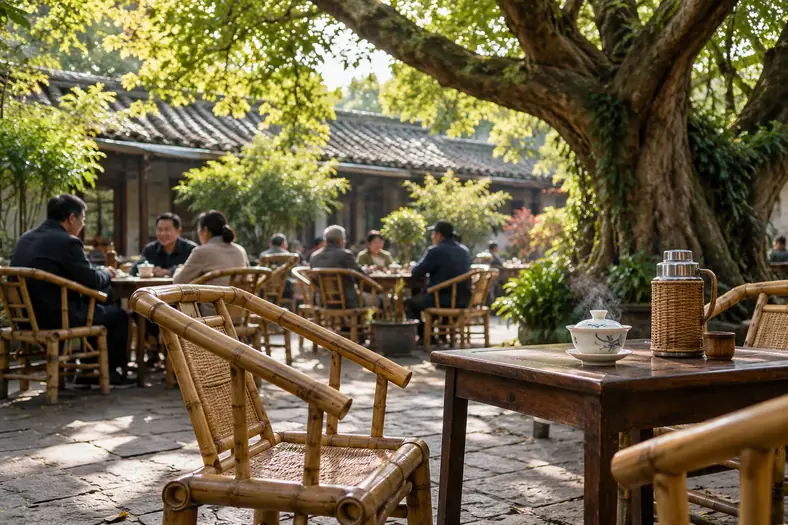
Parks, tea & museums
West and center
People’s Park · Chengdu Museum
Evening Tianfu Square & optional Sichuan opera
See the day’s route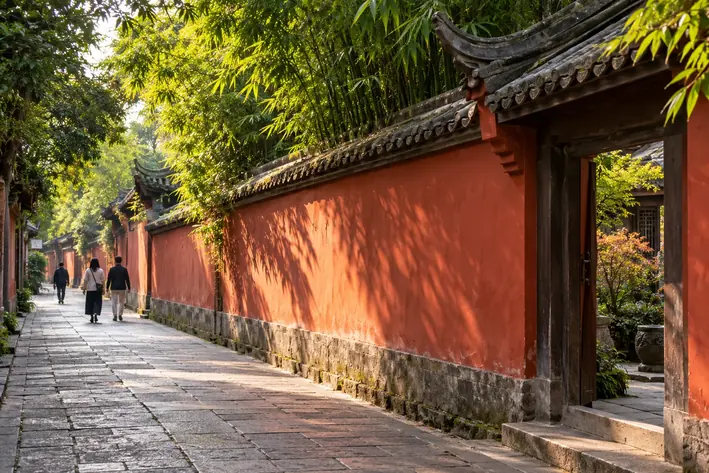
Gardens & the slow south
South and west
Wuhou & Jinli · Du Fu Thatched Cottage
Evening Dinner in Yulin & an optional river walk
See the day’s routeBook these before you arrive
- Panda base: real-name reservation, usually released up to 14 days ahead. Morning entry is the one to take.
- Chengdu Museum: free, but a reservation is normally required. Closed Mondays.
- Sichuan opera: not essential to book weeks ahead, but popular shows sell out in peak season.
- Hotel: central, near a metro station you will actually use. See where to stay.
Panda tickets, museum reservations and some opera tickets are tied to your passport. Carry the physical passport, not just a photo, on days with a booking.
Day one: pandas and the river
The panda base is north of the center and deserves an early start. The rest of the day stays close to the center-east, with a real rest window after lunch. If you are jet-lagged, treat the afternoon as optional and keep the evening short.
- 06:45
- Leave the hotel. A taxi or DiDi is simplest; the metro works if you are close to Line 3.
- 07:30–11:00
- Chengdu Research Base of Giant Panda Breeding. Enter at the South Gate if using the shuttle, walk the main panda houses while it is cool, then see the red pandas before leaving.
- 11:00–12:30
- Return to the center and eat lunch near your hotel. Do not schedule a sight for this slot.
- 13:00–15:00
- Rest. This is not padding; it is what makes the evening enjoyable.
- 15:00–16:30
- Wenshu Monastery: quiet courtyards, tea, and a vegetarian meal if you are hungry again.
- 17:00–18:30
- Taikoo Li and Chunxi Road. Walk through the open-air lanes and visit Daci Temple if it is open.
- 19:00
- Hotpot dinner. Choose a split broth if you want a mild side.
- 20:30
- Walk to Anshun Bridge and Jiuyanqiao for the river at night, then taxi or metro back.
The panda base, without the scramble
The Chengdu Research Base of Giant Panda Breeding is at No. 1375 Panda Avenue in Chenghua District. Tickets can be reserved online by real name up to 14 days ahead. Book through the official WeChat account or an authorized platform, and bring the passport used for the booking. The official ticket page allows on-site purchase in special circumstances when online payment is not possible and tickets remain; advance booking is the better plan.
- Ticket: around ¥55 for an adult; children and seniors have separate rules. Confirm current prices and closures on the official site.
- Hours: roughly 7:30–17:00 from March to October and 8:00–16:30 from November to February, with the park clearing later. Seasonal changes happen; check before you go.
- Getting there: Metro Line 3 to Panda Avenue (熊猫大道), then the 408 shuttle toward the South Gate. Confirm the exit and shuttle at the station. A taxi from central Chengdu takes about 30–40 minutes and costs roughly ¥50–70.
- Timing: pandas are most active in the cool morning. Arrive near opening, walk the outdoor enclosures first, and leave before the midday crowd builds.
- Etiquette: keep your voice low, do not use flash, and do not feed the animals. Some indoor pavilions close on Mondays.
Official panda base website and ticket information (opens in a new tab)
Wenshu Monastery and Taikoo Li
Wenshu Monastery is a working Buddhist monastery with gardens, tea rooms and a vegetarian restaurant. Entry is free and it is usually open daily from around 8:00 to 17:00. Dress modestly, keep voices low and ask before photographing monks or worshippers. Metro Line 1 stops at Wenshu Monastery.
From there, continue to Taikoo Li, the low-rise open-air shopping district wrapped around the restored Daci Temple. It is polished and commercial, but pleasant for an hour of people-watching. Chunxi Road is the busier pedestrian shopping street next door.
Dinner and the river
For a first hotpot, choose a busy restaurant with a split broth (鸳鸯锅, yuānyāng guō), order three or four items per person and use the sesame-oil dip. The food guide explains the ordering logic. After dinner, walk 15–20 minutes to Anshun Bridge; the lit bridge over the Jin River is one of the city’s best free night views. Jiuyanqiao next door has bars and cafés if you want to stay out.
Skip Wenshu and Taikoo Li. Sleep, eat near the hotel, and take a short evening walk. The pandas are the only fixed appointment; everything else can move to another day.
Day two: parks and museums
This is the gentlest day and the best one for rain. It stays west and central, with long pauses built in. The only timed item is the optional opera in the evening.
- 09:00–11:00
- People’s Park and Heming Teahouse. Order tea, sit under the trees and let the morning pass.
- 11:15–12:30
- Kuanzhai Alley: three parallel lanes of snacks, teahouses and souvenirs. Busy, but convenient.
- 12:30–13:45
- Lunch in or near Kuanzhai. Try sweet water noodles or a few shared dishes.
- 14:00–16:30
- Chengdu Museum on Tianfu Square. Free, five floors, and excellent in bad weather.
- 17:00–18:00
- Tianfu Square and a coffee or cold drink nearby.
- 18:30
- Dinner near the center.
- 19:30–21:00
- Optional Sichuan opera at Shufeng Yayun, including face-changing.
People’s Park and Heming Teahouse
People’s Park is free and open from early morning to evening. It is a real neighborhood park: dancers, card players, calligraphers and families, with tea tables at the center. Heming Teahouse (鹤鸣茶社) has been operating in the park since 1923 and is the classic first teahouse experience. A cup of tea costs roughly ¥20–40, hot water refills are free, and you can stay for hours. Ear cleaning is offered by roaming practitioners; agree the price first if you want it.
Metro Line 2 stops at People’s Park. From the park, Kuanzhai Alley is a 10–15 minute walk.
Kuanzhai Alley
Kuanzhai (宽窄巷子) is three restored lanes — wide, narrow and well — of courtyard architecture, snack shops and souvenir stores. It is heavily commercialized and often crowded, but it is also compact, photogenic and easy to combine with the park. Go for the atmosphere and a snack, not for a quiet historic experience.
Chengdu Museum
The Chengdu Museum faces Tianfu Square and is free, with a reservation usually required. It is closed Mondays except public holidays. The collection covers the city’s history from prehistory through the Han dynasty and into the twentieth century, with strong displays of shadow puppets and local craft. Allow about two hours; the top-floor view over the square is a useful orientation.
- Address: 1 Xiaohe Street, Qingyang District, beside Tianfu Square.
- Booking: use the museum’s official WeChat account or website; bring your passport.
- Alternative: Sichuan Museum, near Huanhuaxi Park, is also free and closed Mondays.
Chengdu Museum (English) (opens in a new tab)
Sichuan opera in the evening
Shufeng Yayun (蜀风雅韵) performs in a traditional-style theater in Chengdu Culture Park, next to Qingyang Palace. Shows usually run at 18:00 and 20:00 and last about 90 minutes, with face-changing, fire-spitting, puppetry and comic sketches. Standard seats typically cost ¥120–250; VIP or costume packages cost more. Most tickets include tea, and some tiers add snacks. Arrive 30 minutes early to watch the performers prepare.
Book through the venue, a hotel concierge or a reputable ticketing platform. If opera is not for you, replace it with a longer dinner or a walk along the river.
Stay at the teahouse until lunch, skip Kuanzhai, visit the museum for one hour, and go to the opera. Nobody needs to see all three lanes.
Day three: the slow south
The southern day combines the Three Kingdoms story at Wuhou Shrine, the commercial spectacle of Jinli, the gardens and poetry of Du Fu Thatched Cottage, and a proper neighborhood dinner in Yulin. It involves more walking than day two, but no long transfers until the evening.
The official Jinsha Site Museum notice schedules closure for upgrades from December 5, 2025 through April 30, 2027. Confirm a reopening announcement before making plans. Its Sun Bird gold foil is not on view there during the closure. Du Fu Thatched Cottage is the better use of the same afternoon; the free Sichuan Museum is the indoor alternative.
- 08:30–10:00
- Wuhou Shrine. Go early, before the tour groups and Jinli crowds arrive.
- 10:00–11:30
- Jinli next door: snacks, lanterns and souvenir lanes. Treat it as theater, not archaeology.
- 11:45–13:00
- Lunch near Jinli or Wuhou, then a short rest.
- 13:30–15:30
- Du Fu Thatched Cottage: the poet’s reconstructed home, bamboo gardens and calligraphy.
- 16:00–18:00
- Coffee or a slow walk; return to the hotel if you need a break.
- 18:30
- Dinner in Yulin at a busy neighborhood restaurant.
- 21:00
- Optional: taxi to Jiuyanqiao or Anshun Bridge for a last river walk.
Wuhou Shrine and Jinli
Wuhou Shrine (武侯祠) is the memorial complex for Zhuge Liang and Liu Bei, and one of the few places in China that combines an emperor’s tomb with a shrine to his minister. The gardens are calm, the red walls are photogenic, and the Three Kingdoms exhibits reward a little background reading. Tickets are around ¥50; the official hours are 9:00–18:00 with last entry at 17:00. Book through the official WeChat account or website. Metro Line 3 or 5 to Gaoshengqiao (Exit D) is about an eight-minute walk; Line 10 to Wuhouci is closer.
Jinli (锦里) is directly next door and free to enter. It is a reconstructed commercial lane rather than an ancient street, but it is enjoyable for what it is: lanterns, snack stalls, tea, souvenirs and crowds. Go early or accept the crush. The snack stalls are best for grazing rather than a full meal.
Du Fu Thatched Cottage
Du Fu Thatched Cottage (杜甫草堂) is the garden where the Tang poet Du Fu lived from 759 to 762 and wrote some of his best-known work. The present buildings are reconstructions, but the bamboo, ponds, covered walkways and poetry displays make it one of the calmest paid sights in the city. It is at 37 Qinghua Road in Qingyang District. Tickets are around ¥50; hours are roughly 9:00–18:00, with ticket sales ending at 17:00. The grounds are normally open daily, though some indoor halls may close on Mondays. Metro Line 5 to Qingyang Palace, then a 15-minute walk or a short taxi, is the easiest public-transport route. Allow 1.5–2 hours.
If gardens and poetry are not your priority, swap it for the free Sichuan Museum on Huanhua South Road, which is normally closed on Mondays. For ancient Shu archaeology, note that the Jinsha Site Museum has announced closure for upgrades through April 30, 2027; check its official notice for reopening updates before planning around it.
Yulin in the evening
Yulin is a residential neighborhood with one of the city’s densest everyday restaurant scenes. It is not a single street or a tourist market; the pleasure is in wandering, choosing a busy place with a Chinese menu and ordering a few dishes. Ask your hotel to write “Yulin” in Chinese, or use Amap. After dinner, walk to a café or bar and take a taxi back.
Keep Wuhou and Jinli, shorten the cottage visit to an hour and skip the opera. The panda base is the highlight; do not add a second big attraction on the same day. People’s Park has space to run around and is a better afternoon than a third museum.
Tickets, costs and pacing
The itinerary is designed to be affordable, with one or two paid attractions per day and plenty of free public space. Prices below are planning estimates; confirm them with the venue before you book.
| Item | Estimate | Notes |
|---|---|---|
| Panda base | ¥55 | Adult; real-name reservation, morning entry. |
| Wuhou Shrine | ¥50 | Check current hours and holiday ticketing. |
| Du Fu Thatched Cottage | ¥50 | Allow 1.5–2 hours; some halls may close Mondays. |
| Chengdu Museum | Free | Reservation usually required; closed Mondays. |
| Sichuan opera | ¥120–250 | Standard seats; VIP and costume packages cost more. |
| Metro and taxis | ¥60–120 total | More if you use taxis for every transfer. |
| Food | ¥150–300 per day | Casual meals and one proper dinner; alcohol extra. |
A comfortable budget, excluding the hotel, is roughly ¥300–500 per person per day with a mix of metro, taxis, one paid sight and casual meals. Add the opera, a high-end dinner or daily taxis and it rises quickly.
How to move between the days
- Day one: taxi or DiDi to the panda base; metro Line 3 back toward the center; walking and metro in the evening.
- Day two: metro Line 2 to People’s Park; walk to Kuanzhai; metro or a 20-minute walk to Tianfu Square.
- Day three: taxi or metro to Wuhou; walk to Jinli; taxi or metro Line 5 toward Qingyang Palace for Du Fu Thatched Cottage; taxi to Yulin in the evening.
Pacing rules that actually help
- One anchor per half-day. Everything else is optional.
- Sit down for lunch. Chengdu rewards a long meal more than a fast one.
- Do not cross the city between 12:00 and 14:00 or during rush hour unless you have to.
- Keep one evening completely free. The best night often happens by accident.
- Carry water, tissues, a power bank and a light rain layer every day.
Rain plans and day trips
When it rains
Chengdu’s rain is often steady rather than dramatic, and the city works well in it. Swap outdoor walks for the Chengdu Museum, the Sichuan Museum or a long teahouse session. Du Fu Thatched Cottage has covered walkways but is mostly outdoors, so save it for a dry window. Taikoo Li is open-air but has covered edges and shops. The panda base is still worth visiting in light rain; the pandas are often active and the crowds are thinner, but paths are slippery.
When it is hot
Start at 7:30, spend the middle of the day indoors, and resume after 16:00. Museums, malls and teahouses are the natural refuges. Carry more water than you think you need and use taxis for short hops that would otherwise leave you soaked.
Day trips from Chengdu
- Leshan Giant Buddha: about one hour by high-speed rail from Chengdu East or South, then a bus or taxi to the site. A full day. The boat approach sees the whole figure; the walking route is more strenuous. Book rail tickets with your passport.
- Dujiangyan and Qingcheng Mountain: about 30–40 minutes by high-speed rail to Dujiangyan. The irrigation system is a half-day; Qingcheng Mountain needs another half or a full day. Do not attempt both at a rush.
- Sichuan Cuisine Museum, Pidu: a half-day cooking class and food museum, useful if you want to understand the techniques behind the dishes. Reserve ahead.
- Chongqing: possible by high-speed rail in about 1.5–2 hours, but it deserves an overnight rather than a day trip.
If you have an extra day in the city
Choose one: a slow morning on Wangping Street and the river, the industrial-conversion park at Eastern Suburbs Memory, the university cafés around Sichuan University, or a long afternoon in Huanhuaxi Park. None requires a ticket, and all are more rewarding than adding a fourth museum to a tired itinerary.
Sources and verification
- Chengdu Research Base of Giant Panda Breeding, tickets, hours and transport: panda.org.cn (opens in a new tab).
- Chengdu Museum, opening hours and reservations: cdmuseum.com (opens in a new tab).
- Du Fu Thatched Cottage Museum, tickets and visiting information: cddfct.cn (opens in a new tab).
- Jinsha Site Museum, official temporary-closure notice: jinshasitemuseum.com (opens in a new tab).
- Chengdu Wuhou Shrine Museum, official site and ticketing: whpwm.cdwuhouci.cn (opens in a new tab).
- Chengdu Metro service information: chengdurail.com (opens in a new tab).
- Map geography: OpenStreetMap contributors (opens in a new tab), ODbL.
Page updated October 24, 2026. Opening hours and ticket prices change with season and site policy. Confirm with each venue before you travel, and book only through official channels.